COFEPRIS warns about risks in illegal cannabis products
Claudia Sheinbaum criticized the company Paradise, linked to former president Vicente Fox, for marketing CBD products without Cofepris approval. She assured that any substance not authorized by the Commission will be sanctioned.
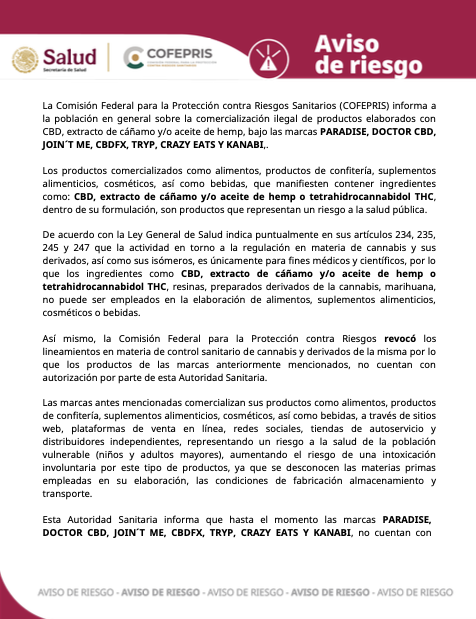
The Mexican government maintains a firm stance regarding cannabis-derived products, classifying them as hazardous to health when they do not follow current regulations. The Federal Commission for the Protection against Health Risks (COFEPRIS) has issued a health alert on the illegal marketing of products made with cannabis-derived ingredients, including CBD, hemp extract and hemp oil.
Brands targeted
COFEPRIS has identified the following brands marketing products without sanitary authorization:
PARADISE
DOCTOR CBD
JOIN’T ME
CBDFX
TRYP
CRAZY EATS
KANABI
These products, which include foods, food supplements, cosmetics and beverages, pose a risk to public health.
Why do they pose a risk?
According to Articles 234, 235, 245 and 247 of the General Health Law, the regulation of cannabis and its derivatives is restricted exclusively for medical and scientific purposes.
Articles 234, 235, 245 and 247 of Mexico’s General Health Law state the following:
Article 234: This article defines which substances are considered narcotic drugs for the purposes of the law. These include:
Cannabis sativa, indica and American Cannabis or marijuana, its resin, preparations and seeds.
In addition, other substances such as opium and its derivatives, cocaine and its derivatives, among others, are mentioned.
Article 235: This article regulates the activities related to the narcotics mentioned in the previous article. It establishes that such activities, such as production, distribution, trade, possession and use, require authorization from the Ministry of Health and are subject to the provisions and requirements determined by it.
It is important to note that Mexican law considers cannabis and its derivatives as narcotic drugs, and their handling is strictly regulated by the health authorities.
This means that the use of ingredients such as CBD, THC, hemp extract or hemp oil in products for general consumption is not allowed.
In addition, COFEPRIS has revoked the guidelines on the sanitary control of cannabis, so none of these brands have official authorization.
Possible health risks
The aforementioned products could represent a danger for consumers, especially for vulnerable populations such as children and older adults, due to:
Lack of control over the raw materials used.
Lack of knowledge of manufacturing, storage and transportation conditions.
Possible unintentional intoxication.
Unknown interactions with medications.
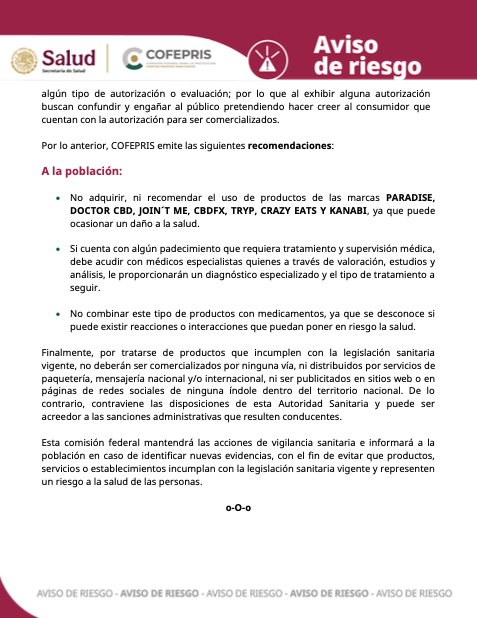
COFEPRIS Recommendations
COFEPRIS has issued the following recommendations:
Do not purchase or consume products of these brands.
Consult with a specialized physician in case of requiring treatments related to cannabis.
Avoid combining these products with medications without medical supervision.
In addition, the sale, distribution and advertising of these products within Mexico is prohibited. Any company marketing these products may face administrative sanctions.
Cannabis regulation in Mexico remains in legal limbo, but 2025 could mark a turning point. With the growth of the international market and pressure from investors, the government could be forced to define clear rules for the production and commercialization of cannabis and its derivatives.
Experts point out that the Supreme Court of Justice of the Nation (SCJN) has issued rulings in favor of recreational consumption since 2018, but the lack of political will has held back comprehensive legislation. However, the recent controversy between Claudia Sheinbaum and the company Paradise, linked to Vicente Fox, shows that the issue remains high on the public agenda.
Sources close to the Senate indicate that in the coming months the discussion of a law regulating cannabis for commercial and medicinal purposes could be resumed, allowing national companies to compete in a market that, according to estimates, could generate more than 2 billion dollars annually in Mexico.
Meanwhile, entrepreneurs in the sector demand clear rules for operating, arguing that the lack of regulation only benefits the black market.